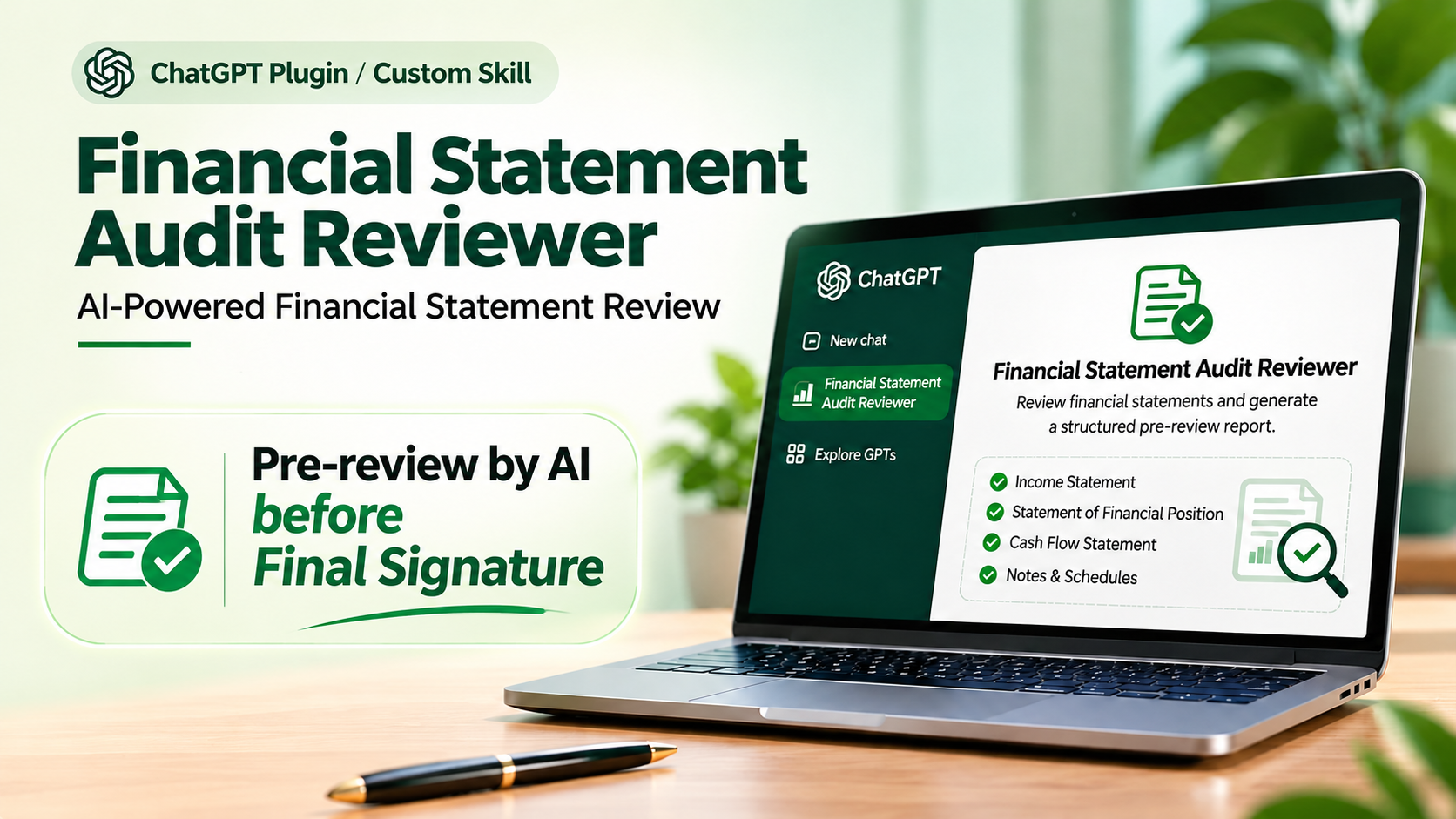
A financial statement can look complete and still contain inconsistencies. A total may not agree, a cash flow figure may differ from the statement of financial position, or a supporting schedule may not reconcile with its related note. Finding these issues before a report is finalised is an important part of a disciplined financial reporting review.
I am MD Mahfuzur Rahman from CA Profession. During my CA articleship, I had the opportunity to work on financial statement audits for organisations across different industries. My experience included two buying houses, one export-oriented garment manufacturer, two export-oriented private companies, one travel agency, one public limited company, and more than ten large and medium-sized NGOs. This exposure gave me practical experience with financial statements, supporting schedules, notes to the accounts, cash flow statements and audit report preparation.
The recurring problem that inspired me to build this ChatGPT custom plugin
Across these assignments, I repeatedly faced a frustrating issue: small but important mistakes in financial statements and audit reports. These could be calculation differences, inconsistencies between statements, incorrect figures in notes, mismatched references or presentation issues.
Sometimes, minor errors came to light after a report had already been shared for review. We then had to revise the report and send an updated version to the client—occasionally more than once. It was uncomfortable and time-consuming, and it reinforced how even a small oversight can affect the professionalism of the reporting process.
I started thinking about a practical way to catch more of these issues before a report reached the client. Could an AI assistant help perform a structured preliminary review, highlight possible inconsistencies and give the reviewer another opportunity to investigate them? That question eventually led me to develop Financial Statement Audit Reviewer Plugin, an AI-assisted tool designed to make preliminary review more organised and help reduce avoidable errors before finalisation.
Why financial statement review matters
Before financial statements are finalised, reviewers need to consider whether the primary statements agree with one another, whether supporting schedules support the reported balances, and whether notes and disclosures are complete and presented consistently. A review may include checks such as:
- Confirming that total assets agree with total equity and liabilities in the Statement of Financial Position.
- Comparing the current-year result in the Statement of Profit or Loss with the related movement in the Statement of Changes in Equity.
- Reconciling closing cash and cash equivalents in the Cash Flow Statement with cash and bank balances in the Statement of Financial Position.
- Checking property, plant and equipment schedules, including additions, disposals, depreciation and closing written-down value.
- Reviewing note references, opening and closing balances, comparative figures, tax amounts, reporting dates and entity names.
These checks can take considerable time when performed manually across multiple worksheets and report pages. A structured review process helps reduce the chance of overlooking an inconsistency.
Where AI can help
AI can assist with reading supplied documents, comparing figures and highlighting items that may need further investigation. For example, if a Cash Flow Statement reports a closing cash balance that differs from the cash and bank balance in the Statement of Financial Position, an AI-assisted review may flag the difference and point the reviewer towards the relevant statements.
The purpose is not to replace the reviewer. It is to help organise preliminary checks, surface possible issues and give the professional more time to investigate the matters that require judgement.
Introducing Financial Statement Audit Reviewer ChatGPT Plugin
Financial Statement Audit Reviewer is a custom ChatGPT plugin I developed to support preliminary financial statement review. It is designed to examine supplied financial statement files and prepare a structured report of potential findings. You can Download the plugin from the tool page or explore the project repository.
Key review areas
- Mathematical accuracy: totals, subtotals and arithmetic consistency.
- Cross-statement reconciliation: related figures across the primary financial statements.
- Schedule verification: supporting schedules and their corresponding financial statement balances.
- Notes and cross-references: consistency between notes, schedules and statement references.
- Opening and closing balances: comparative-year and brought-forward balance checks.
- Disclosure, presentation and language: potential omissions, inconsistent labels and drafting issues.
How to use it
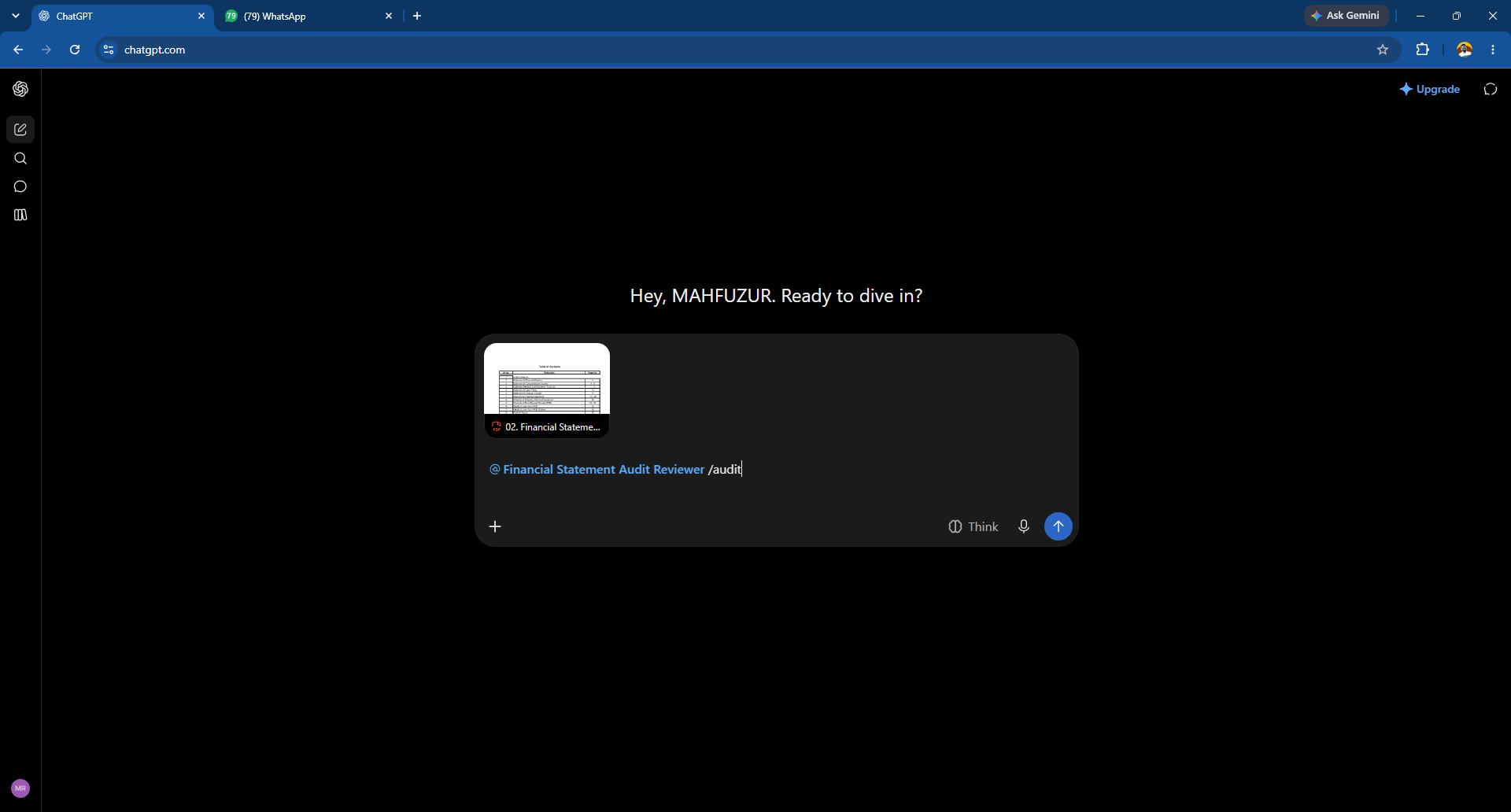
Upload the financial statement file you want to review in ChatGPT and use the relevant command. The /audit command requests an English review report, while /auditbd requests a Bangla-English report. The ChatGPT custom plugin is designed to return a document containing actionable findings, explanations and suggested follow-up actions, rather than simply filling the chat with a long list of checks.
Treat every finding as a review point. Check it against the original schedules, ledger, supporting documents and other audit evidence before making an adjustment or concluding that an error exists.
Step-by-step installation and usage guide
The following screenshots walk through the process, from uploading and installing the ChatGPT custom plugin to starting a review and viewing the generated report.
Step 1 — Upload the plugin: follow the illustrated steps to add the plugin to your ChatGPT workspace.
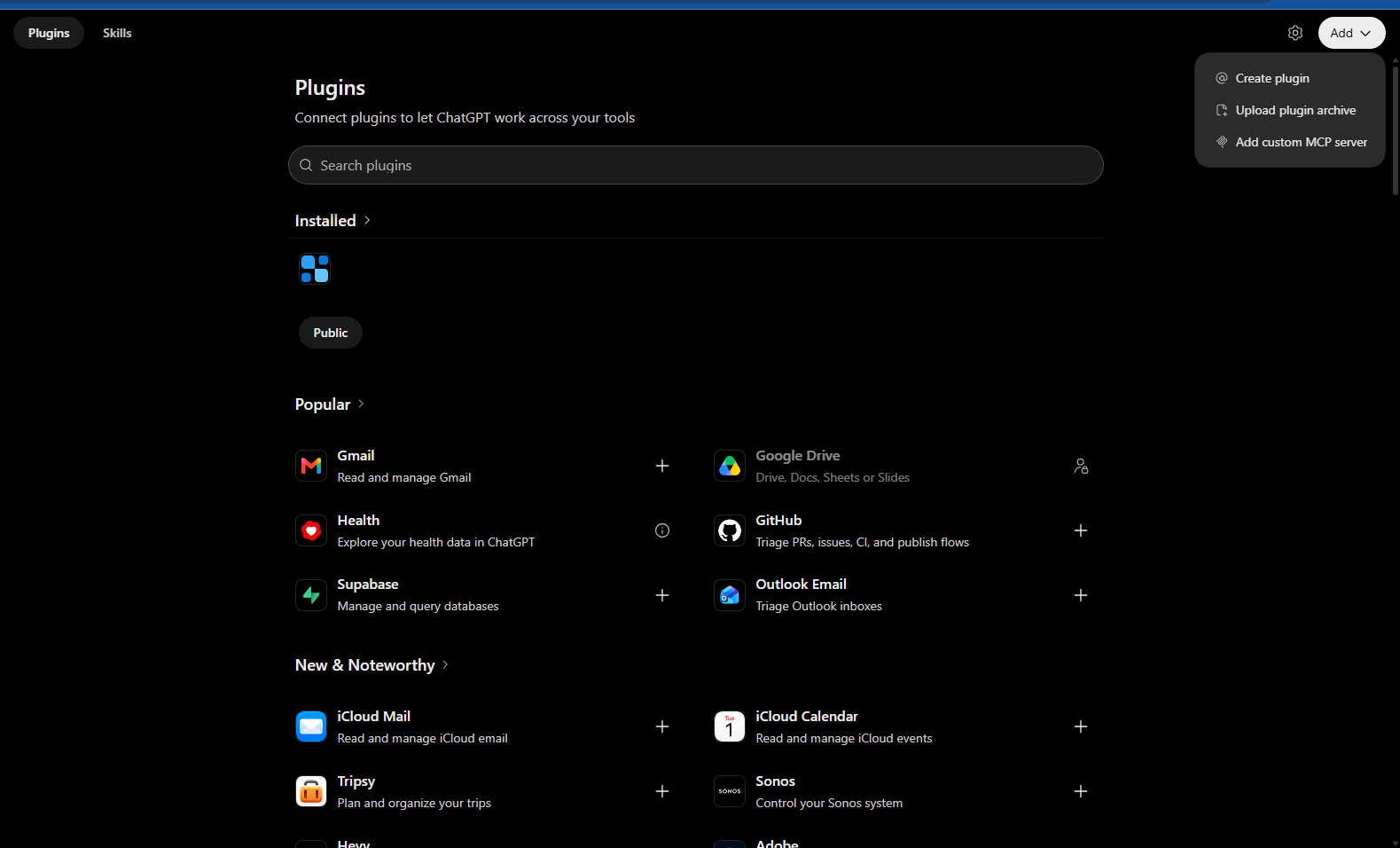
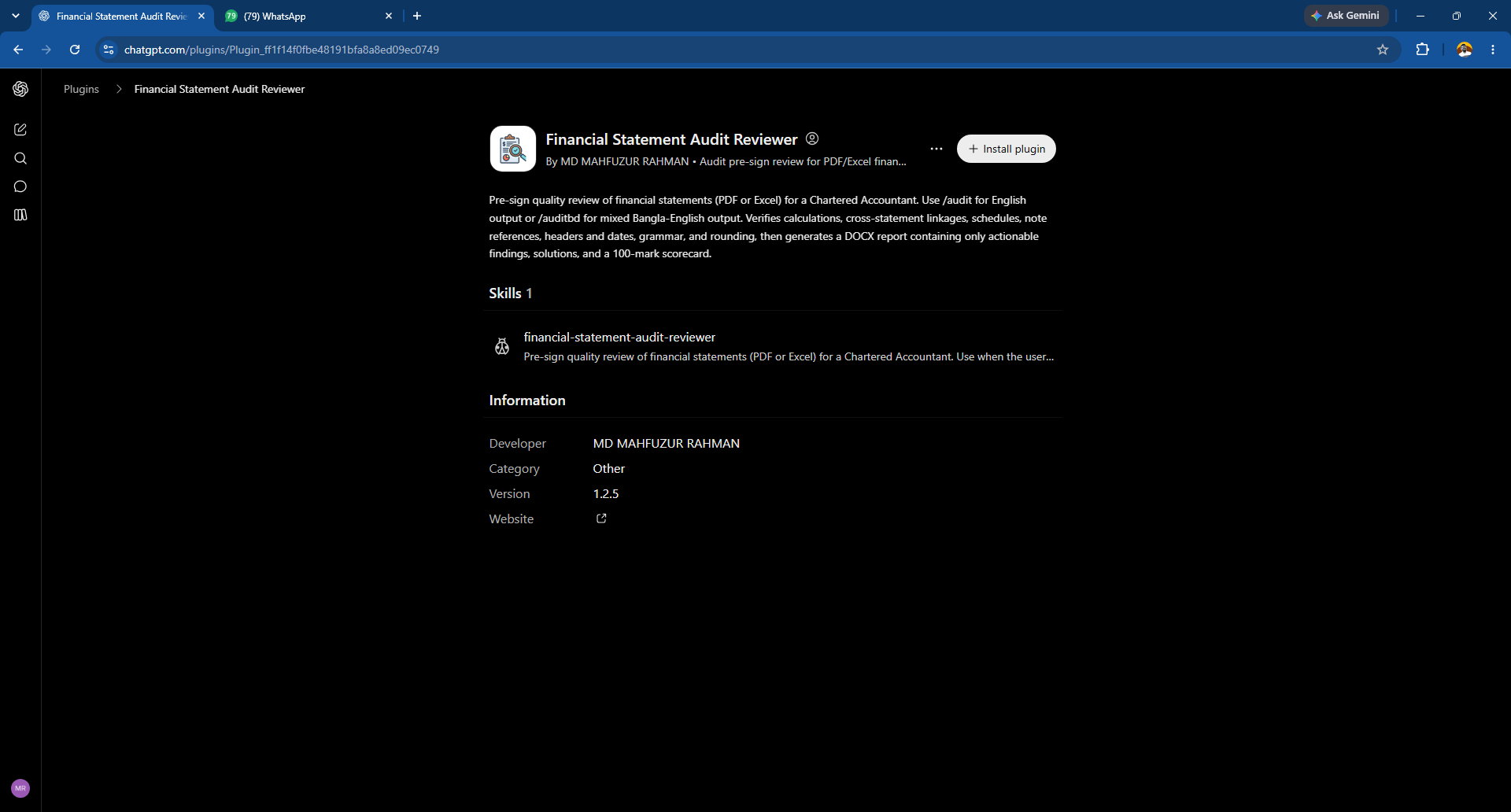
Step 2 — Install the ChatGPT custom plugin: complete the installation process so it is available in ChatGPT.
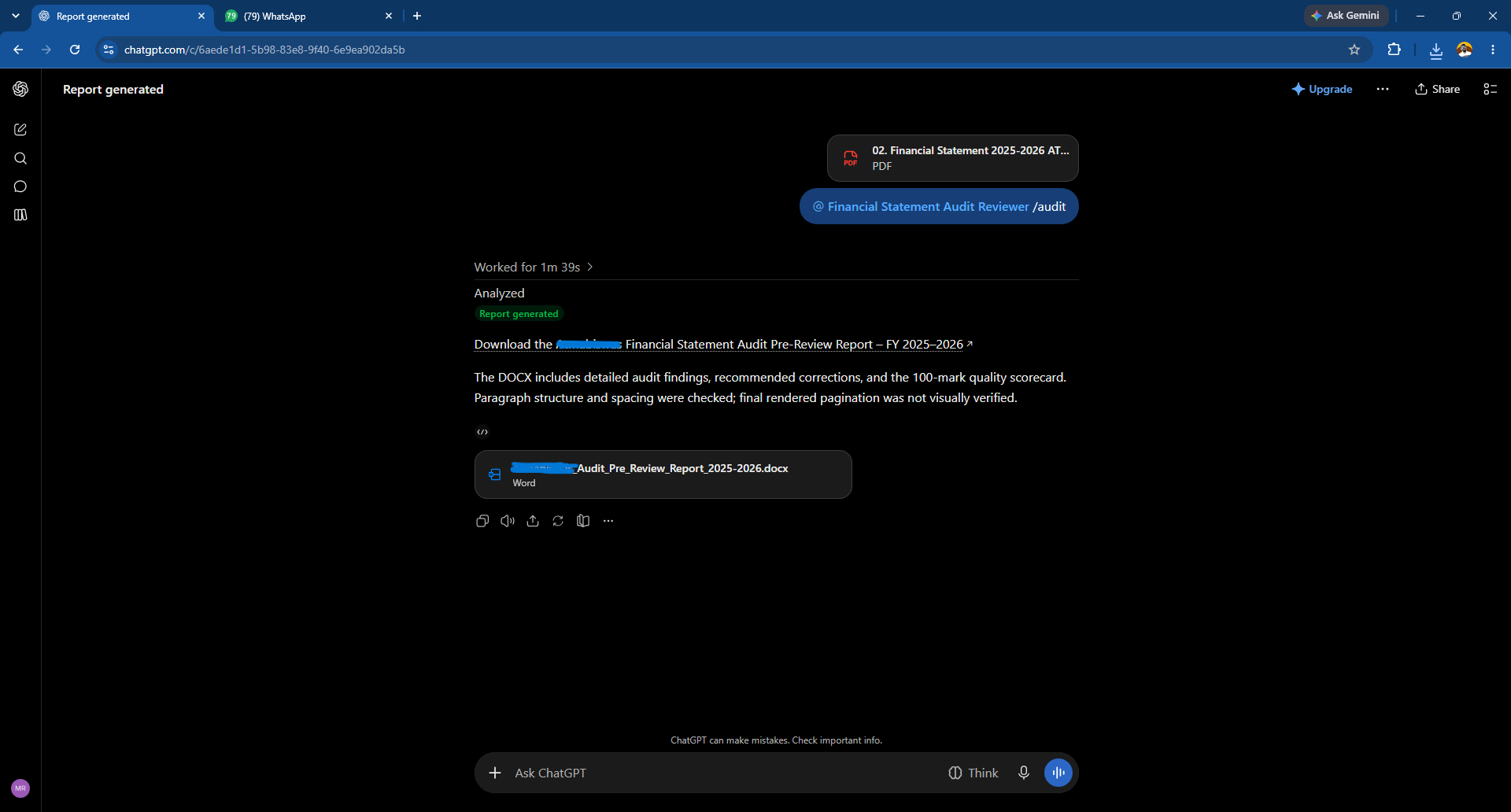
Step 3 — Start a review: upload your financial statement file and use /audit for an English report or /auditbd for a Bangla-English report.
Step 4 — Download the output result from Chatgpt. Sample output — an example of the structured review report generated by the ChatGPT custom plugin. Findings should always be checked against the original records and supporting evidence.
Who may find it useful?
The ChatGPT custom plugin may be useful to CA articled students, audit trainees, audit associates and seniors, accountants, and financial reporting professionals who work with draft financial statements and supporting schedules. It is intended as an additional review aid within an existing professional workflow.
Important limitations
Financial Statement Audit Reviewer is an AI-powered preliminary review assistant. It does not provide an audit opinion, assurance, certification or professional sign-off. AI may misunderstand context, miss errors or flag items that are not errors. Users must verify outputs against source records and applicable reporting requirements. Responsibility for professional judgement, audit procedures and final approval remains with the qualified professional.
A ChatGPT custom plugin built from practical review experience
I developed this ChatGPT custom plugin to make repetitive preliminary review work more structured and to explore how AI can support accounting and audit workflows. I hope it will be useful to other professionals and students working with financial statements.